
Brand Google Ads campaigns cost on average $0.77 per click in Q1 2026, up from $0.24 ten years ago — a rise I track every month across 27 accounts. Yet in nearly every account I audit, brand campaigns add no value over a free organic click, because the configuration is wrong.
A few acronyms come back throughout this article: Cost Per Click (CPC), Cost Per Acquisition (CPA), and Return On Ad Spend (ROAS). They refer respectively to the price paid per click, the cost of generating a conversion, and the ratio of revenue to ad spend. Search Engine Optimization (SEO) and Customer Relationship Management (CRM) software will also come up.
- Advertisers run brand campaigns to shield their traffic from competitors, but they don’t optimize for the actual needs and audiences of people searching for their brand.
- Many advertisers waste budget defending a brand no competitor is even targeting, which hurts pure acquisition.
- Routing brand traffic to the homepage adds zero value over an organic click. You need different pages tailored to each audience and each need.
- The Target Impression Share bid strategy is suboptimal compared to Smart Bidding.
- Sitelinks show up less than half the time and aren’t reliable enough to push alternative pages to users (study with hard numbers below).
- Brand campaigns are essential for pre-heating Smart Bidding targeting, especially in industries with low intent-driven traffic.
- When a brand campaign degrades, the impact is immediate and compounds over weeks across the whole account, particularly on new prospects (study with hard numbers below).
- SEO alone can’t protect all the traffic a brand can capture. A brand campaign on Google Ads remains essential, even on a small budget.
What brand Search campaigns should actually do
A brand Search campaign serves five distinct purposes that justify its existence even when SEO already covers brand queries:
- Defend your brand by always showing a sponsored link in first position before competitors who also bid on your name.
- Use sitelink assets to surface multiple landing pages on the search results page, so users can jump straight to the section that matches their need. For example: product categories in ecommerce, or the pricing page for a SaaS.
- Promote a specific advertising message: a special offer, social proof, a strong reassurance argument that an organic result simply can’t display.
- Within the ad, change the final URL to send brand-interested traffic to one or more pages other than the homepage.
- Strengthen Google Ads Smart Bidding by feeding it easy conversions from ideal prospects that Google will learn to recognize and target on acquisition campaigns.
That combination isn’t explicitly documented by Google: the official documentation on Search campaigns stays generic about use cases. The operational framework is left to advertisers to build. Search Engine Land’s analysis of paid+organic incrementality makes the same point: without clear intent, a brand campaign only cannibalizes organic.
Brand click costs in Search (2024-2026 study)
Here’s an internal study to give you a sense of what we actually pay for clicks on our clients’ accounts (panel of 27 to 30 accounts depending on the period):
| Metric | 2024 | 2025 | Q1+ 2026 |
|---|---|---|---|
| Total brand cost | $281,996 | $328,879 | $104,721 |
| Brand clicks | 294,400 | 384,226 | 137,502 |
| Average brand Cost Per Click (CPC) | $0.96 | $0.86 | $0.77 |
Source: internal study on 30 anonymized accounts. Scope: every campaign whose name contains “Brand” or “Marque”, all channels combined. Original EUR figures converted to USD at today’s rate (1 EUR = $1.17). Data extracted via the Google Ads API as of 2026-04-23.
The good news: cost-per-click on your own brand doesn’t suffer the same inflation as generic keywords. Plus, you can drive it down significantly with the optimizations I cover in the next article in this series.
$0.77 per click may sound cheap. But between 2015 and 2020, I was used to CPCs around $0.24 (sometimes a few cents), and it stings to pay this much for brand clicks in 2026. Especially since nothing justifies the increase — Google has shipped no real innovation around brand traffic.
At 24 cents a click, our clients didn’t even bother optimizing brand campaigns; they were a tiny fraction of total ad spend. In 2026, it’s become a budget line you have to actively manage.
And unfortunately, too many advertisers spend on their brand without getting any added value in return.
Why you’re right to limit brand spend — when it’s done poorly
A company expects its ad budget to flow first to audiences that don’t know the brand or who hesitate to buy. So it’s natural for a decision-maker to frown when a big chunk of budget gets eaten by brand clicks, when an SEO click costs nothing.
This intuition is partly backed by industry studies. Per a Search Engine Land analysis of two A/B tests, about 33% of brand-ad traffic is cannibalized from organic, and 67% remains incremental. A broader Google study puts incrementality at 88% — but Google has an obvious interest in defending that number.
A decision-maker is right to be skeptical about brand spend, especially when the brand campaign is, symbolically, just holding the front door of the store open. It gives the customer no signal about where to find what they’re looking for, nor does it surface any current promotion.
A Google Ads agency typically defends brand spend with: “I’m protecting the brand from competitors who bid on it.” Sometimes true, often overstated.
When does aggressive brand protection make sense?
A brand becomes a historical leader, or a popular one through media exposure (PR, TV, YouTube campaigns, creator partnerships). At that point, it creates its own demand instead of relying on generic queries that express market demand.
For example, a user types “iPhone” rather than “smartphone” — because the iPhone isn’t just any smartphone, it’s the iconic smartphone. Same for brands like Carglass. They aren’t products, they are the product.
Companies with that level of recognition become ideal targets for competitors, who can tap into the leader’s audience to pitch an alternative offer or positioning.
For most companies, reality is grayer: they get targeted by competitors more by accident than by deliberate intent.
It’s rarely worth bidding on a competitor’s brand on Google Ads — those clicks are far more expensive than generic, market-demand keywords.
Example from a hyper-competitive market:
- Cost per click on “best CRM”: $23.39
- Cost per click on “HubSpot”: $44.37
Source: Keyword Planner, April 2026
This gap between generic and competitor-brand keywords is confirmed by the WordStream 2025 benchmarks, which measure similar CPC variation across industries.
It’s also harder to flip a user who is about to buy from a competitor. Better to invest in people who are still exploring options without a clear preference.
So it’s rare for an advertiser to invest heavily on competitor keywords if their own market demand isn’t already fully covered by the ad budget.
But things have shifted in the past few years:
- Google is aggressively pushing Performance Max campaigns, Search campaigns with AI Max, and broad match keywords — all of which trigger impressions on competitor names.
- In many industries — SaaS, urgent-service trades (plumbing, locksmiths) — query CPCs have become absurd ($55+) and bidding on competitor brands becomes tempting because they’re more affordable. This isn’t a niche trend: per the WordStream 2025 benchmarks, average Google Ads CPC has gone up in 87% of industries, and for SaaS keywords WordStream reports bids that can exceed $100.
Advertisers now target each other, often without realizing it. So you have to invest heavily through your brand campaign whenever Google Ads’ Auction Insights show competitors present on your brand.
But if competitors aren’t there — or are there by accident — that argument alone doesn’t hold up.
How to know if a competitor actually bids on your brand on Google Ads
Follow this procedure:
- Open your Google Ads account, then select the Search campaign that buys your brand keywords.
- Pick a date range of at least 7 days.
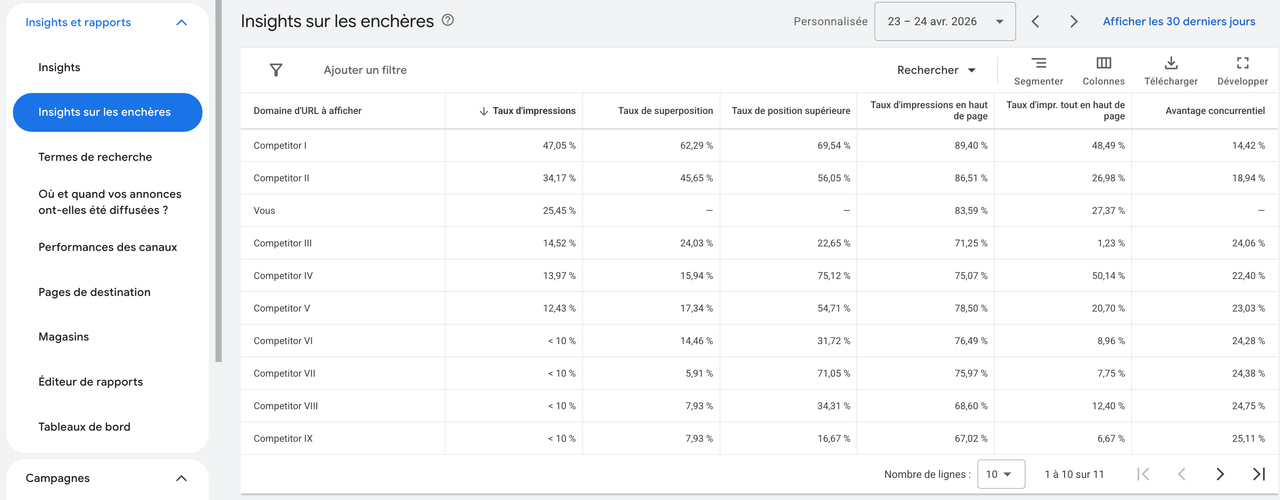
- In the “Insights and reports” menu, click “Auction insights”.
- You’ll get the list of advertisers showing up on your brand.
Important note: if a Search campaign mixes brand keywords with generic keywords, first select the ad group that contains ONLY the brand keywords. If brand keywords are mixed with generic keywords inside a single ad group… it’s time to switch agencies!
Two scenarios:
1) You’re alone on your brand
If the “Insights and reports” section only shows your brand, no one is targeting you. That’s normal for a small business or a low-awareness brand.
If no competitor targets your brand, paying for brand traffic without the configuration I’m about to walk through is a waste of money. Your brand traffic is already covered by SEO at $0/month.
2) You’re not alone on your brand
If you see other advertisers on the report, look at how aggressively they’re targeting you and how well your brand is defended:
- Impression share is the percentage of times a competitor bids on your brand keywords. If a competitor exceeds 30% impression share, defending your brand becomes worthwhile.
- Top of page impression share is the percentage of times your competitor manages to land in the very top position on Google (i.e., above you). If a competitor’s top-of-page impression share exceeds 25%, that means:
- The competitor is willing to bid very high to get your traffic, which usually means it’s profitable for them.
- You’re not bidding aggressively enough to outrank them.
The accidental targeting case
Competitors sometimes appear with impression shares around 15% or below 10%. In that case, the targeting is accidental. It’s most likely their broad match keywords or Performance Max campaigns automatically bidding on you.
When this happens: reach out to them politely, point out that they’re showing up on your brand and that it’s probably not profitable for them either. Suggest they exclude your brand from their account, and let them know you’ll do the same on yours.
Everyone wins. Except Google, of course…
The deliberate targeting case
It’s perfectly legal in France, in Europe, and in the U.S. to bid on a competitor brand, as long as the competitor’s name doesn’t appear in the ad text and doesn’t create confusion.
The use of a trademark as a keyword infringes on the origin function only if the ad doesn’t allow a normally informed and reasonably attentive internet user to determine whether the products/services come from the trademark owner or a third party.
Source: CJEU, 22 September 2011, C-323/09 — Interflora v. Marks & Spencer
So you can’t force a company to stop bidding on a competing brand if they comply with the law. You’re forced to buy your own brand traffic to prevent competitors from siphoning off too much of it.
Why you shouldn’t pay for brand clicks to the homepage
Advertisers who simply buy their brand traffic and dump it on the homepage are throwing money out the window.
In most audits we’ve run, the brand campaign structure looks like this:
- One ad group,
- Brand keywords in phrase or exact match,
- One ad pointing to the homepage.
That’s it.
This lazy setup adds no value to the business, even though we’re talking about paid clicks, not free ones. We’re looking at an investment of at least $12,000 per year on average across our clients.
- Value for the user: zero — they land on the homepage, exactly like they would have with an organic click. The “but the ad is different, we repeat our offer” excuse doesn’t justify $0.71 × 100+ clicks per day.
- Value for the advertiser: no page optimized to present the offer clearly and concisely, free from SEO constraints. No conversion-rate gain, no associated revenue lift.
The performance gap between a homepage and a dedicated landing page is massive: Unbounce measures a median 6.6% conversion rate on dedicated landing pages (study on 41,000 pages and 464 million visitors), versus 2 to 3 times worse on a generic homepage. Details and concrete application to brand traffic in the second article of this series.
Why Google Ads native features aren’t enough to make brand campaigns profitable
Let’s review the options Google Ads gives us to add value to a brand-campaign user.
Sitelinks: the false friends
When a user searches your brand on Google, a properly configured brand campaign can return up to 7 clickable links: the ad’s destination URL plus 6 other pages of your site. The block on the results page can be massive.
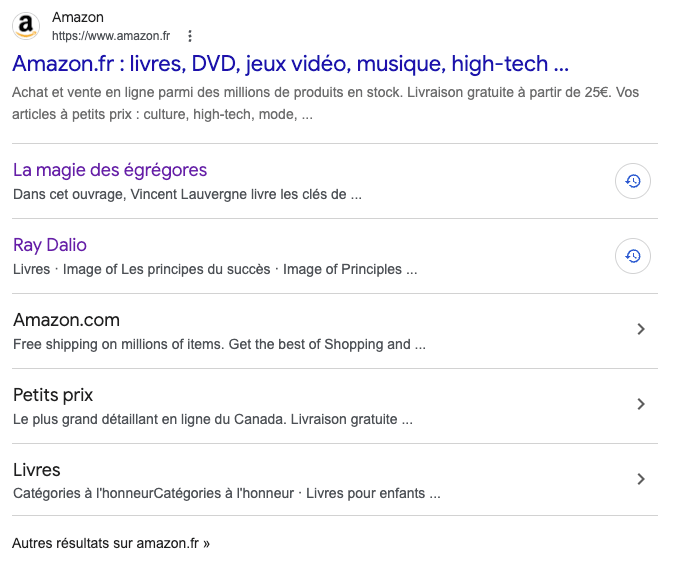
Those 6 extra pages are sitelink ad assets. For each, you set a link and two description lines.
Recommended sitelinks by business type:
For ecommerce sites:
- Product categories,
- Customer reviews page,
- Shipping and returns page,
- Buying guides.
For services sites:
- Service categories,
- Individual service pages,
- Service-by-location pages,
- Customer reviews page,
- Pricing page.
Google then decides which sitelinks actually show. That’s bad news, for three reasons:
- You can’t force the most relevant sitelinks for a specific query. Google sometimes hits the target. Sometimes.
- You don’t control the order. Two less-relevant links can land first and push more important ones too far down.
- You’re not even guaranteed sitelinks will show at all. You might get 6, 4, 3, or 2. It’s not rare to get zero, while a competitor lands four.
The number of sitelinks is heavily correlated with your position on the SERP. The higher you rank in paid results, the more links show up. The more you try to save on CPC, the more you suppress sitelink display. That naturally pushes you to pay more per click over time.
And that would be acceptable — if Google actually showed sitelinks consistently…
Users click sitelinks less than half the time (study)
For external comparison: WordStream reports that an ad in first position with sitelinks displayed reaches 46.9% Click-Through Rate (CTR). Our study refines that figure by industry.
Here’s a meta-analysis of sitelink display rate by industry: CTR = ad click-through rate
| Category | Brand CTR min. | Brand CTR max. | Brand CTR median |
|---|---|---|---|
| B2B | 16% | 58% | 40% |
| B2C services | 19% | 52% | 28% |
| Ecommerce | 41% | 69% | 55% |
Source: internal study on 27 anonymized Google Ads accounts, data extracted via the Google Ads API, all-time, on 97,095,291 sitelink impressions. Impressions are deduplicated at the ad-impression level, even when several sitelinks show simultaneously.
Even when Google shows them, sitelinks are clicked only 28% to 55% of the time depending on the industry. They aren’t enough on their own to route the user to the right page.
Bottom line: yes, sitelinks are useful, but if they’re your only lever to shape the customer journey, they’re not enough.
Ad copy: extra CTR, but limited impact on conversion
In SEO, your main keywords go in the <title> tag and the description must present the brand itself. Tweaking those tags to highlight a temporary special offer risks degrading your rankings.
It’s smarter to use the Search ads you’re paying for as billboards where the content can change as often as you want.
Here’s what to highlight in brand campaign ads:
- Special offers: e.g., the headline discount for Black Friday (in addition to the Promotion ad asset, of course).
- Brand reassurance elements: e.g., satisfaction guaranteed, lifetime warranty.
- Common objection-handling: “No X”, “Returns if Y”, “Cheaper than Z”.
It’s good to push aggressive headlines and offers, but:
- Most advertisers send brand traffic to the homepage, which doesn’t always reflect the offers and promises stated in the ad. That creates a disconnect between what the user just read in the ad and the first page they land on.
- Users have a goldfish memory, and you also have to assume they read the ad in full.
- The user might be aware of a special offer. But once on the homepage, they need to find where to redeem it: menus, the right page, a promo section, a code to enter at checkout, etc.
The undeniable benefit of strong brand ad copy: a sharp hook can dramatically lift your CTR (ad click-through rate), which is one of the components that brings cost-per-click down.
Bottom line: changing ad copy is useful, but it doesn’t move the needle much on brand campaign profitability.
Why the homepage hurts conversion rates for audiences who already know your site
The homepage acts as a “portal” presenting your brand, your offers, and your products. Unless you have a one-page site, it rarely converts on its own. It’s supposed to “pass the ball” to specialized pages.
Three limits with the homepage:
-
First limit: it defends every service and product simultaneously. It dilutes attention and the brand’s ability to spotlight the right product/service, with the right message and more space to lay out the argument. The result: lower conversion rate, and lower ad profitability. If you yourself can’t find a piece of information on your own site within three seconds, don’t expect a visitor to find it in 10 seconds. They’ll likely already be gone.
-
Second limit: the homepage is political. Externally — it has to address everyone, those who know you and those who don’t. Internally too. The CEO loves it. The comms team dropped its best punchline there to “build a brand universe”. The designer spent four days deciding the right sidebar should be teal blue, not Prussian blue. Modifying that page for advertising purposes triggers internal friction. If you’re a consultant or marketing manager, you probably already know this is a minefield where you’ll often end up with a watered-down compromise that pleases no one.
-
Third limit: not every audience needs the same homepage:
A user who already knows your brand doesn’t need to re-read the value proposition or the company story — they know it already. What they need is to pick up where they left off in their buying journey and find content that will tip them into converting this time, or repeat-purchasing without friction.
A user who doesn’t know the brand but is flagged as “very warm” by Google (lots of prior searches, YouTube history, competitor visits…) will have less patience than you think. They’re in a hurry. Yours is probably the 4th site they visit between two metro stops or with a fork in their other hand. You’re already the 4th option they’re considering. A “smooth” homepage will turn them off, while a deliberately stripped-down page focused on the strongest arguments, offers, and promotions for their context has a better shot at convincing them to buy from you.
My recommendation is to plan dedicated, customized pages for every audience type to maximize ROI on brand campaigns. I detail in my article on brand campaign optimization how to build a complete system tailored to each prospect type.
Why brand campaigns are essential to pre-heat the Google Ads algorithm
Sales or leads from brand campaigns are the cheapest you can get across the entire account. If a brand is already established, you almost have to try to not convert through a brand Search campaign. And if that’s the case, your problem isn’t Google Ads — it’s your offer.
Google Ads is a unique platform. Unlike Meta Ads or LinkedIn Ads, in 2026 it’s still incapable of identifying a precise audience on its own. You have to feed it conversion signals so it can build a picture of your ideal customer. You can’t, like LinkedIn Ads, simply tell Google to target “HR Directors at companies with 100+ employees” on day one.
The bulk of Google’s ecosystem still relies (in 2026) on intent-driven traffic: users have a need, they express it as a query like “HRIS software”. Google then gives us a chance to show up at that moment.
In B2C, when demand is so strong and unambiguous — like “buy solar panels” — getting leads isn’t hard. But when an entire business depends on targeting a fraction of an audience — say, solar panels for businesses — Google has no idea how to address that audience slice.
You have to send Google Ads as many conversions as possible from your ideal prospects so it can find similar prospects in the rest of your campaigns.
That’s where the brand campaign comes in.
A brand campaign captures cheap traffic from an audience that’s already in-target — they know you and they’re spending their precious time researching your products and services. The hardest part is already done. By sending conversions to Google Ads tracking on every contact form or purchase, you send Google a representative sample of the prospects to target on generic keywords.
In industries like SaaS or B2B high-ticket, click prices have become prohibitive. Search volumes have also shrunk because of Large Language Models (LLMs like ChatGPT). The result: it’s become impossible to perform without first pre-heating your Google Ads account with your brand campaign.
This is documented by Search Engine Land across 13 months of data. Zero-click searches now account for 69% of queries per Similarweb. LLM-referred traffic grew 80% in the second half of 2025.
But careful with the headline. Another Search Engine Land study shows that LLM traffic converts worse than organic Google traffic. Each remaining Google visit therefore becomes even more valuable and contested.
Case study: audience specialization through brand
In 2022, we took over an account in construction selling concrete for cladding — but only for architects and installation contractors. That represents a tiny market segment lost in the mass of homeowners wanting to clad their houses. Without applying the logic above, this client had an unavoidable problem: too many homeowners reaching out to the sales team.
We used the brand traffic to “reset” the account’s learning while blocking form submissions from homeowners. Within a month, the pro-customer rate jumped from 30% to 100%.
Over the following months, Google Ads completely stopped targeting homeowners. It learned where to look.
That’s one example among many of how powerful a brand campaign is for strengthening Google Ads acquisition. Investing in this type of campaign is essential whenever your target audience isn’t obvious. In 2026, using Smart Bidding is the norm. What makes the difference is the quality of the data you feed it. On one side, an account that takes off in a month. On the other, an account that has to be killed within 6 months for lack of ROI.
To launch an account on a complex market, it’s not unusual for us to start by spending 75% of the budget on brand and only 25% on acquisition before progressively rebalancing. The early acquisition lag gets recovered in subsequent months, and it often unblocks accounts that wouldn’t take off otherwise.
Summary: do you actually need a brand campaign?
To decide in practice how much effort to put into a brand campaign, two conditions cover 95% of cases on their own. Here’s the decision tree I use when I take over a new account:
The two right-hand verdicts (Smart Bidding feeder and SEO-only) assume you have already checked Auction Insights and confirmed that no competitor consistently holds more than 30% of your brand impression share.
The two viable bid strategies for brand Google Ads campaigns
There are two viable bid strategies for brand Search campaigns, each with strengths and weaknesses: Target Impression Share and Maximize Conversions / Conversion Value.
Target Impression Share
With the Target Impression Share bid strategy, the advertiser asks Google Ads for a specific impression-share percentage at a target position (e.g. 95% top of page) for a maximum cost per click.
Some advertisers use the Manual CPC strategy, but the logic is the same: it’s a bet on market price. Note that this strategy is explicitly classified by Google as automated bidding rather than Smart Bidding (Search Engine Land analysis), which is why it ignores audience-level and location-level bid adjustments.
Pros:
- You cover every potential click, as long as the budget holds.
- You arbitrate via the maximum CPC — more aggressive against greedy competitors, more conservative to drive average CPC down and find a “sweet spot” between always being present and overpaying Google.
Cons:
- You show an ad to every user regardless of intent: the curious bystander and the future buyer ready to convert get the same bid.
- A competitor who suddenly bids harder can outpace you. During a Black Friday window, that can hurt badly.
Target Impression Share is the bid strategy chosen by the vast majority of advertisers. It’s simple, it gets the job done, but it lacks subtlety and doesn’t reward the best clicks.
I no longer use Target Impression Share on brand campaigns — I use Smart Bidding exclusively. My reasoning: in a market where clicks are getting more expensive and budgets are shrinking, I don’t want to pay for every click that organic could deliver for free. I want to buy the clicks of warm prospects who are too valuable to leave to competitors.
Smart Bidding strategies
Maximize Conversions with Target CPA and Maximize Conversion Value with Target ROAS are two compelling bid strategies for a brand campaign. The technical breakdown of each Smart Bidding strategy is documented in Search Engine Land’s Smart Bidding guide.
In practice, you tell Google: prioritize impressions on the best potential prospects.
Pros:
- You no longer take every click — only the ones that absolutely shouldn’t go to competitors.
- You can lower brand campaign cost without losing — and often while increasing — conversion value.
- The brand campaign’s Smart Bidding helps the acquisition campaigns’ Smart Bidding, as I explained above.
Cons:
- Clicks can be more expensive.
- Google needs to learn to identify those “best clicks” via a minimum conversion history, which makes this option a poor fit at account launch.
- You have to arbitrate the Target CPA (or Target ROAS) regularly. Too high and you’ll overpay for clicks. Too low and you’ll under-deliver and leave the field open to competitors. This isn’t for advertisers who want to touch the account once a month.
In my next article I cover a third option that takes the strengths of Target Impression Share and adds the precision of Smart Bidding.
Should you let Performance Max handle brand traffic?
Performance Max is an “all-in-one” campaign type that delivers ads on every channel: Search, Shopping, Google Maps, Display, Demand Gen (covering YouTube, Discover, and Gmail).
A Performance Max campaign is a black box whose success depends entirely on the volume and quality of conversion signals you feed it. The “garbage in, garbage out” rule applies more strongly to Performance Max than to any other Google Ads campaign type.
- If your Google Ads account has solid conversion history AND your tracking only reports qualified sales/leads, Performance Max campaigns let you scale an account easily. Plan on up to 6 weeks of learning to perform as well as or better than Search.
- If your tracking is unreliable, or you have low sales/form-submission volume, Performance Max will burn budget on poor-quality placements. It won’t know where to look.
The problem: most advertisers (outside of ecommerce) rarely meet the prerequisites for the first scenario (good tracking + conversion history).
Because Performance Max needs huge conversion volume to perform, it loves serving on brand to grab easy conversions. Partly to learn — but mostly to keep the dashboard looking good for the advertiser at all costs.
This behavior is documented in detail in Search Engine Land’s article on brand exclusions for Performance Max, which shows that PMax prioritizes brand queries to inflate apparent ROAS. The Search Engine Land 2026 recommendations confirm this exclusion approach. Google eventually rolled out native brand controls in Google Ads, implicitly acknowledging the need for separation.
Some advertisers like to delegate brand traffic management to Performance Max, betting that Google will route a brand-searching user to the most relevant page on the site — and bid more on priority clicks.
For most accounts, which don’t have huge budgets and perfectly configured tracking, letting a Performance Max campaign handle brand traffic means letting Google do the job halfway. Performance Max does everything, average. And “average” in 2026 — when CPCs are spiking and demand is shrinking — is no longer enough.
I’m certain of one thing: on Google Ads, it’s always better to keep control. When one campaign coughs, the whole account catches a cold. Automation makes sense when an account becomes so sprawling that it’s humanly impossible to cover all demand with specialized campaigns or ad groups.
Our advertisers spend between $2,500 and $12,000/month in ad budget, excluding the largest accounts. At those spend levels, fully manual account management is preferable. The erratic management of an algorithm designed to spend before performing wastes budget.
Optimizing a brand Search campaign is the easy win any rigorous consultant can deliver, because the market still doesn’t know how to leverage these campaigns properly in 2026.
Bottom line: I recommend excluding the brand from Performance Max campaigns and doing the work yourself.
What happens when a brand campaign collapses (case study)
In March 2025, when we took over an account, we found it had just lost 91% of its brand click volume in a single week. Not gradually — in 5 to 7 days flat. It’s only by going back through the previous 10 months of history that we discovered the full extent of the problem: the account had been hit by several successive shocks since May 2024, never fully recovering between them.
Cause: several mishandled campaign transitions.
What’s striking: the account’s overall traffic barely moved; 60% of that traffic came from direct visits and existing users. The collapse only hit one specific audience: new prospects in the consideration phase, the ones who explicitly search for the brand after an ad exposure or a word-of-mouth recommendation. It’s the most valuable traffic — the one that won’t come back without advertising.
Monthly data hides what actually happened. Here’s the weekly timeline of the critical moments:
| Week | Click index | Event | Immediate impact (new-customer revenue) |
|---|---|---|---|
| W19 2024 | 100 | Normal baseline | — |
| W21 2024 | 21 | Abrupt campaign shutdown | −79% in one week |
| W26 2024 | 28 | Relaunch with new budget | Partial — never recovers initial level |
| W31 2024 | 37 | Uncovered transition | −48% additional |
| W43–W44 2024 | 49–73 | Successive campaign transitions | Chronic instability |
| W12 2025 | 5 | Near-disappearance | −91% vs baseline |
Index 100 = baseline week (annual peak). Weeks W22–W25 and W13–W14 are omitted because they were stable, even at very low levels.
Every drop in the brand campaign hit the business directly. The account never recovered to its baseline level between successive crises. And every time a transition was poorly covered (bid strategy change, CPA → ROAS switch, end of campaign without immediate replacement), a new drop occurred.
Brand Impression Share drops by 20 to 30 points during a crisis. Click volume gets divided by 4 to 10. The impact on new sign-ups is measured in dozens to hundreds of qualified leads missed per week of disruption, depending on the account’s typical volume.
SEO doesn’t pick up the slack if your Google Ads brand campaign falters. SEO covers traffic from users who already know you and who type your URL directly. It doesn’t catch prospects searching for your brand for the first time after seeing an ad or hearing about you. If you stop capturing that traffic via ads, your brand loses on pure acquisition.
This dependency between paid brand and organic is documented in a Hewlett-Packard case analyzed by Search Engine Land: when HP cut its SEM, organic only recovered 36% of the traffic instead of the 46% expected. The shortfall isn’t visible immediately — but it materializes over time, exactly like the client case above.
How to set up a brand campaign properly
Building a brand campaign isn’t about putting the brand keyword in phrase match inside an ad group with one ad and Target Impression Share as the bid strategy.
There’s much more to do. Optimizing a brand campaign can paradoxically be the most profitable quick-win in an entire Google Ads engagement. Across the 27 accounts we manage, 4 to 6 hours of reconfiguration are typically enough. Brand CPC drops by 15% to 30%. New-prospect conversion rate gains 20% on average. Especially since the 2026 Google Ads trends (WordStream) confirm that automation and AI will keep invading every campaign layer, which makes mastering brand traffic even more critical.
I strongly recommend reading my article on the perfect setup for a brand campaign in the next article to avoid every mistake we’ve covered together here.
Feel free to share your own brand-campaign experiences in the comments.